AI Autoblogging Tools Keyword Research Pricing: What Should You Pay?
Keyword research is where most AI autoblogging budgets quietly disappear. Some tools charge per search, others bundle credits into monthly plans, and the gap between free tiers and paid ones decides how many articles you can actually publish.
This article breaks down what Autoblogging.ai includes at each pricing tier, how credits, modes, and volume drive the final cost, and what free versus paid keyword research really delivers. By the end, you will know which plan fits your publishing volume and whether the price is worth paying.
What Is Autoblogging.ai and How Does It Handle Keyword Research?
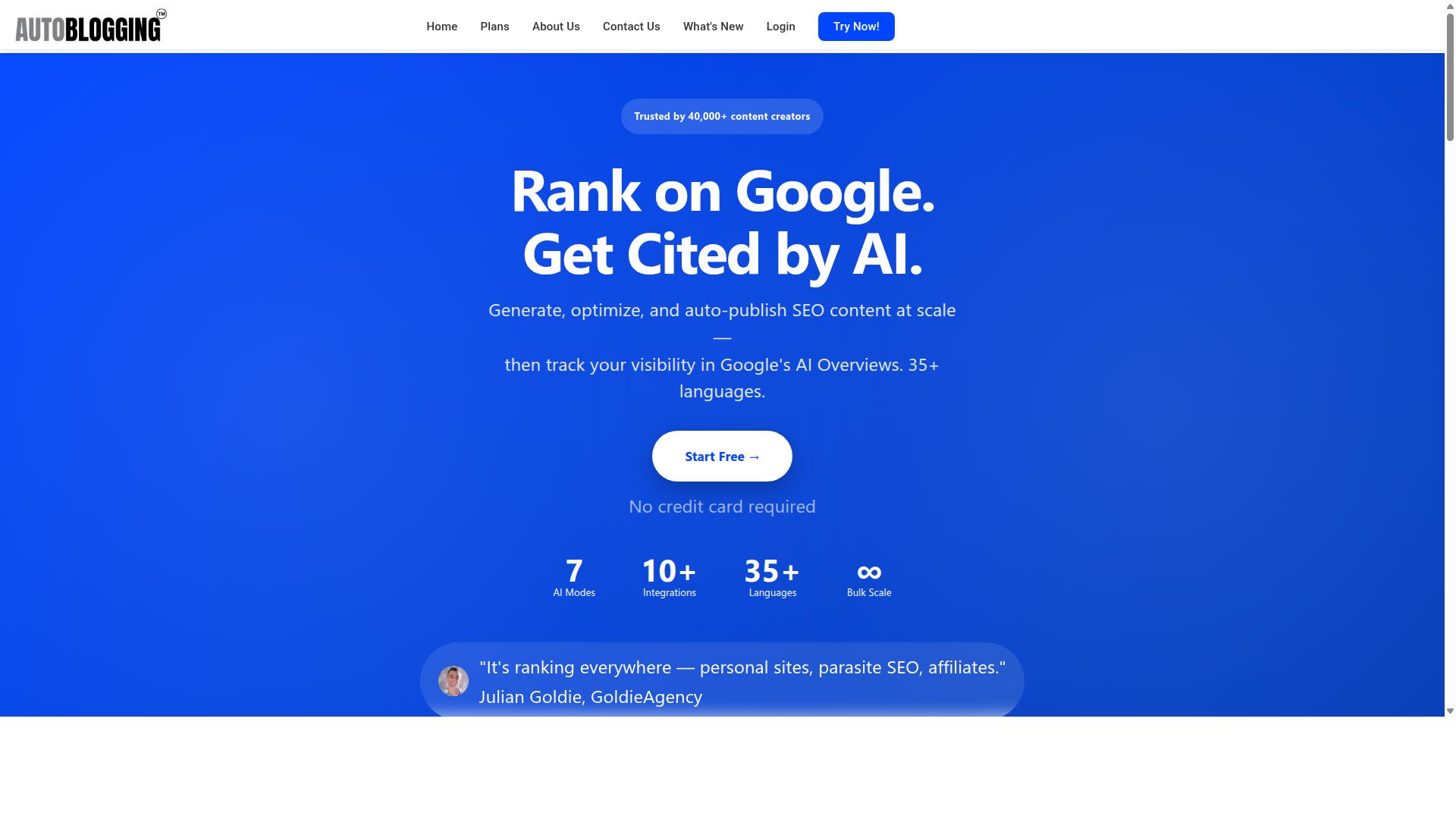
Autoblogging.ai is an AI-powered content generation platform that automates keyword research and article creation for bloggers, agencies, and SEO professionals. It is a product of Digimetriq.com, built with a clear mission: help bloggers, website owners and agencies save time and improve their online presence through cutting-edge technology.
What separates Autoblogging.ai from a standalone keyword tool is the way the two halves of content production sit in one place. Keyword research and article generation are not separate subscriptions or disconnected workflows. They feed into each other.
That matters for anyone weighing up AI autoblogging tools keyword research pricing. When a single platform covers both discovery and drafting, you are not paying twice for overlapping capability. The cost per article and the cost per keyword stop being two line items and become one.
Autoblogging.ai also positions itself as a cost-cutting layer rather than a replacement for every human task. The stated aim is to cut down content costs and give the power to human counterparts in SOPs with the first draft. That framing matters when you assess value for money, because the platform is designed to slot into an existing process rather than demand a full rebuild of it.
The sections below look at who the platform serves and how its keyword research engine actually operates inside the workflow.
Who Autoblogging.ai Serves and What It Does
Autoblogging.ai is designed for bloggers, website owners, SEO professionals, marketing agencies, content creators, and affiliate marketers who need to produce high-quality content at scale. That is a broad audience, and the platform supports it with a matching spread of use cases.
Named scenarios include personal sites, parasite SEO, affiliate sites, client websites, portfolio sites, and local sites. A solo blogger publishing to one domain and an agency managing many client websites are both served, though their needs differ sharply.
Core functionality falls into three buckets:
- AI article generation through modes such as Quick Mode, Godlike Mode, Bulk Generation, News Mode, and Amazon Reviews Mode
- Keyword research built into the generation workflow rather than sold as a separate product
- Automation and publishing through WordPress integration, Web 2.0 platforms, and multi-platform support
Bulk Generation can produce up to 500 articles via CSV, which speaks directly to agencies and affiliate marketers running large portfolios. Publishing reaches WordPress with unlimited sites, one-click posting, a plugin, and scheduled auto-posting. Web 2.0 destinations include Medium, Dev.to, Hashnode, Telegraph, and Tumblr, while multi-platform support covers Shopify, Wix, Webflow, Blogger, and Ghost.
Beyond generation, there is a layer of optimization tooling: Site Optimizer, Semantic SEO Analysis with a 21-point audit, Snippet Optimizer, Topical Maps, Intense Optimizer, Fan Out Queries, AI Infographics, Outreach Prospects, and both an AI Proofreader and a Human Proofreader. API access, Zapier, n8n, and a Content Repurposer round out the workflow. Done For You packages are available for users who want the output handled end to end.
For pricing purposes, this breadth is the point. A solo blogger plan and an agency plan may look similar on paper, but the value comes from how many of these functions replace paid tools elsewhere in your stack.
How Keyword Research Works Inside the Platform
Inside Autoblogging.ai, keyword research is powered by Godlike Mode, which performs SERP competitor analysis, extracts LSI keywords, and leverages knowledge graphs to identify high-potential topics.
Because keyword research sits inside the same platform as article generation, there is no export, no reformatting, and no second subscription. The keywords you uncover feed the content you produce.
For buyers comparing subscription cost across tools, that consolidation is where affordability arguments get made. A separate keyword research platform plus a separate AI writer means two monthly fees, two learning curves, and two sets of limits on keyword volume data and article generation volume. Autoblogging.ai folds both into one workflow.
It is also worth noting what the broader toolset adds on top. Topical Maps and Fan Out Queries extend keyword work into content planning, while Semantic SEO Analysis and the Snippet Optimizer help refine what gets published. Each of those capabilities is a line item you would otherwise source elsewhere.
When you evaluate AI autoblogging tools, ask whether keyword research is a genuine part of the engine or a bolt-on. In Autoblogging.ai, it is the first stage of the same pipeline that produces the article.
What Should You Actually Pay for AI Autoblogging Keyword Research?
When budgeting for AI autoblogging keyword research, consider factors like credit consumption, mode selection, and the volume of keywords you need to analyze. The right number is not a single figure. It depends on how often you publish, how deep your analysis needs to go, and whether you are running one blog or several.
Keyword research sits at the foundation of every autoblogging workflow. Without it, an AI writer produces content around topics nobody searches for. With it, each article targets real search demand and has a genuine chance of ranking. That is why keyword research is not a nice-to-have add-on. It is the step that determines whether the rest of your budget produces results.
Pricing models in this category vary widely. Some tools bundle keyword research into a flat monthly fee or annual plan. Others use credit-based billing or pay-per-use pricing, where each keyword lookup or article consumes part of your balance. Tiered pricing is common, with a free trial or freemium model at the entry point and advanced features reserved for higher tiers.
Two cost drivers matter most: how the tool charges (subscription vs credits) and how much you use it. A solo blogger with one site has very different needs from an agency managing dozens. Before comparing plans, map your actual output. A realistic estimate of articles per month and keywords per article will tell you more than any feature list.
Also watch for hidden fees, renewal charges, word count limits, and API access fees that sit outside the headline price. A refund policy or money-back guarantee reduces the risk of choosing wrong. The sections below break down what actually moves the cost up or down.
What Drives the Price: Credits, Modes and Volume
The cost of AI autoblogging keyword research is primarily driven by the number of credits consumed, which vary based on the generation mode and the volume of keywords or articles processed. Understanding this structure helps you predict your bill instead of guessing at it.
Modes are the first lever. A Quick Mode performs lighter analysis and consumes fewer credits per run. It is well suited to straightforward topics where you mainly need seed keywords and basic suggestions. A more advanced mode, often called Godlike Mode, digs deeper into search intent, competitor pages, and related terms. That extra work costs more credits because the system processes far more data per request.
Volume is the second lever. Credits scale with how much you generate:
- Analyzing a handful of seed keywords costs far less than processing hundreds at once.
- Bulk generation multiplies credit use in direct proportion to the batch size.
- Longer articles with higher word count limits consume more credits than short posts.
- Keyword clustering and LSI extraction add processing steps, which add cost.
A practical example: a blogger publishing a few short articles per week on a single niche might stay comfortably within a modest credit allowance. An agency producing dozens of long-form posts across multiple client sites will burn through credits quickly and should plan for a higher tier or a larger credit pack.
The takeaway is that credits make spending predictable and controllable. You can dial the mode down for routine posts and reserve advanced analysis for competitive keywords where the extra depth pays off. This flexibility is a genuine advantage over flat-rate tools that charge the same whether you publish five articles or fifty.
Free vs Paid Keyword Research: What You Get at Each Tier
Autoblogging.ai offers a free Quick Mode for basic keyword research, while paid plans unlock advanced features like SERP competitor analysis and LSI keyword extraction. That split defines the real decision: when does free stop being enough?
At the free tier, you get a functional starting point. Quick Mode surfaces keyword suggestions so you can test the workflow, validate a niche, or plan a small batch of posts without spending anything. For a new blogger experimenting with a first site, this is often sufficient to prove the concept. The trade-off is depth and volume. Free usage typically comes with lower limits on how many keywords you can process and does not include the deeper analytical layers.
Paid tiers change the picture in three ways:
- Depth: SERP competitor analysis shows what already ranks, so you can target gaps rather than guess.
- Breadth: LSI keyword extraction and clustering build topic coverage that supports stronger rankings.
- Volume: higher credit allowances and word count limits support consistent publishing at scale.
When does upgrading make sense? When keyword research stops being a test and becomes a production requirement. If you publish regularly, run multiple sites, or handle client work, the free tier's limits will slow you down. The jump from free to paid is less about unlocking one feature and more about removing ceilings on output.
Assess it as value for money rather than raw price. If a paid tier lets you research and publish enough content to grow organic traffic, the cost per article and cost per keyword drop as volume rises. For a solo blogger, an entry paid plan is usually the natural next step. For agencies, a higher tier with generous credits supports scaling costs across many projects without constant top-ups. Start free, measure your real usage, then upgrade when the limits, not the marketing, tell you to.
Autoblogging.ai Pricing and Plans Explained
Autoblogging.ai offers tiered monthly and annual subscription plans designed to accommodate users from solo bloggers to large agencies. The pricing model is straightforward: every plan is credit-based, and each credit converts into article generation capacity.
This structure matters for anyone weighing a subscription cost against real output. Instead of paying a flat monthly fee for unlimited access you may never fully use, you pay for the volume you actually need. A credit-based billing model keeps spending aligned with content production rather than locking you into a fixed, overprovisioned tier.
There are six tiers in total. Starter, Regular, and Standard serve individuals and small teams. Gold and Premium target growing agencies, while Enterprise handles large-scale operations with heavy daily output needs. All plans include credits rollover, and new accounts receive 10 free credits per month with no credit card required. That free allowance functions as a low-risk way to test the platform before committing to a paid tier.
Additional credits are available for purchase if your needs spike mid-cycle. Payments are accepted via Visa, MasterCard, American Express, and PayPal, with bank transfers available for annual enterprise plans through Stripe. You can cancel anytime. The sections below break down the monthly and annual options in detail.
Monthly Plans: From Starter to Enterprise
Monthly plans range from the Starter plan at $19 for 40 credits to the Enterprise plan at $999 for 5,000 credits, catering to different content production needs. The full monthly lineup is as follows:
- Starter at $19 for 40 credits, suited to hobbyists testing the waters
- Regular at $49 for 120 credits, a fit for solo bloggers publishing consistently
- Standard at $99 for 300 credits, aimed at small businesses with steady output
- Gold at $179 for 600 credits, built for growing agencies
- Premium at $249 for 1,000 credits, designed for established agencies
- Enterprise at $999 for 5,000 credits, for large-scale operations
The progression is deliberate. A hobbyist producing a handful of posts each month has no reason to pay agency-level rates, and an agency juggling dozens of client sites would exhaust a Starter allowance almost immediately. Matching the tier to your output is the single biggest lever on value for money.
Credits roll over on every plan, so a slow month does not mean wasted spend. If you generate fewer articles than your allowance in one cycle, the balance carries forward. That flexibility is a meaningful advantage over pay-per-use models where unused capacity simply disappears.
For readers thinking about cost per article, dividing the monthly fee by the credit allowance gives a rough working figure. The higher tiers generally deliver a lower effective cost per credit, which is why agencies tend to scale up rather than stack multiple small plans.
Annual Plans and Credit Rollover Value
Annual plans offer significant savings compared to monthly billing, and unused credits roll over, providing flexibility for users with fluctuating content needs. The discount is substantial across every tier:
- Starter: $12 per month, billed as $148 per year
- Regular: $32 per month, billed as $382 per year
- Standard: $64 per month, billed as $772 per year
- Gold: $116 per month, billed as $1,396 per year
- Premium: $162 per month, billed as $1,942 per year
- Enterprise: $649 per month, billed as $7,792 per year
The gap between monthly and annual rates is easy to see. Starter drops from $19 to an effective $12 per month. Enterprise falls from $999 to $649. For anyone committed to ongoing content production, the annual plan is the clear value play.
Credit rollover deserves separate attention. Because balances carry forward, a subscriber who publishes heavily in one quarter and lightly in the next does not lose the difference. This directly addresses one of the most common frustrations with subscription tools: paying for capacity that expires unused. Rollover turns unused credits into stored value rather than a sunk cost.
For agencies with seasonal client demand, or businesses whose keyword research cycles produce uneven publishing schedules, that carryover protects the budget allocation you have already made. There are no hidden fees attached to the rollover feature, and the same payment methods apply.
Autoblogging.ai also offers Done For You packages for buyers who prefer a hands-off route: Starter at $1,200 for 1,000 articles, Pro at $1,600, Corp at $4,000, and Senpai at $10,000. These sit alongside the subscription tiers rather than replacing them, giving teams a second path when in-house publishing capacity is the bottleneck. Combined with cancel-anytime terms and a free credit allowance to start, the pricing structure is transparent and scales cleanly from a single blog to enterprise-level output.
Key Features That Justify the Cost
Autoblogging.ai justifies its cost through advanced features like Godlike Mode, bulk generation, and integrations that streamline content creation and boost ROI. When you compare the monthly fee against the hours of manual work each feature replaces, the value becomes easier to see.
Not every mode costs the same to run, and that matters for pricing. The platform offers a free Quick Mode for single articles and a wizard flow, which gives new users a way to test the tool before spending anything. Paid value concentrates in the modes that do heavier lifting, such as Godlike Mode and Bulk Generation.
Beyond writing, the platform bundles optimization and publishing tools that would otherwise require separate subscriptions:
- Site Optimizer and Semantic SEO Analysis, a 21-point audit
- Snippet Optimizer, Topical Maps, Intense Optimizer, and Fan Out Queries
- AI Infographics, Outreach Prospects, AI Proofreader, and Human Proofreader
- Content Repurposer for turning existing articles into new formats
This bundling is central to the affordability question. A solo blogger or agency comparing subscription costs should weigh the full stack, not just article output, because consolidated tools reduce total spend across a content workflow.
Godlike Mode: SERP Competitor Analysis and LSI Keywords
Godlike Mode performs in-depth SERP competitor analysis, extracts LSI keywords, and uses knowledge graph extraction to produce highly optimized content. It is the premium tier of the writing engine, and its cost reflects the research work it replaces.
For anyone paying per article or per credit, this changes the math on cost per article. Manual SERP research for a single keyword can take a meaningful chunk of time, and doing it across dozens of keywords multiplies that effort. Godlike Mode compresses the research stage while improving topical coverage, which is exactly the kind of value for money that justifies a higher tier.
It also supports smarter budget allocation. Because the mode targets semantic relevance rather than keyword stuffing, the articles it produces are better positioned to compete for search visibility, which is the outcome most subscribers actually pay for. If your keyword research process currently involves spreadsheets of search volume, keyword difficulty, and CPC data, Godlike Mode folds a comparable layer of analysis into the generation step itself.
Bulk Generation, Integrations and the Human Proofreader
Autoblogging.ai supports bulk generation of up to 500 articles, integrates with 35+ tools, and includes a human proofreader to ensure quality at scale. For agencies and publishers, these are the features that turn a subscription into an operational asset.
Bulk Generation accepts a CSV of keywords and produces articles in volume, which directly affects cost per article. The more articles a plan generates, the lower the effective cost of each one, so scaling costs favor users who commit to higher volumes rather than paying per piece.
Publishing and workflow integrations remove another layer of manual labor:
- WordPress integration with unlimited sites, one-click publishing, a plugin, and scheduled auto-posting
- Web 2.0 platforms including Medium, Dev.to, Hashnode, Telegraph, and Tumblr
- Multi-platform support for Shopify, Wix, Webflow, Blogger, and Ghost
- API access, plus Zapier and n8n for automation
The Human Proofreader adds an editorial pass that AI-only tools typically lack, which matters when content quality affects brand reputation. An AI Proofreader is also included for faster automated checks. Together, these features explain why the subscription cost covers more than raw text generation, and why the platform holds up as value for money rather than a bare per-word expense.
Trust Signals: Track Record and Testimonials
Autoblogging.ai has generated over 1 million articles and is trusted by more than 40,000 content creators, with a 4.9 average rating. Those numbers matter when you are weighing subscription cost against real value, because a platform with this kind of usage history has already been stress-tested by a large user base.
For anyone comparing monthly fees or annual plans, track record is often the clearest indicator of whether a tool will still be around, and still improving, a year from now. A 4.9 average rating across tens of thousands of users is not something a product earns by accident.
It reflects consistent delivery on the basics that matter: reliable article output, sensible keyword research features, and pricing that users feel is worth renewing. When you calculate cost per article or cost per keyword, that reliability is part of the equation.
A cheap tool that produces unusable drafts is expensive in practice. A platform with a proven volume of output gives you a stronger basis for estimating your own ROI and budget allocation.
Beyond raw numbers, Autoblogging.ai backs its track record with tangible product depth. The platform offers 10+ AI modes and supports 35+ languages, which means the same subscription can serve multiple content formats and audiences without extra tools or add-on fees.
It also includes a human proofreader in all plans and a 21-point SEO audit, features that directly affect the quality of what you publish. For buyers worried about hidden fees, knowing these capabilities are bundled rather than upsold is a meaningful trust signal.
Credits rollover is another point in the platform's favor. Instead of losing unused article generation volume at the end of a billing cycle, you keep it, which improves value for money for anyone whose publishing schedule fluctuates month to month.
Support matters too. Autoblogging.ai provides 24/7 support, and new features ship weekly, so the tool you pay for today is not frozen in place. That ongoing development is a form of trust: it shows the team is invested in the product's longevity.
Testimonials from recognized names in the content and SEO space add another layer of confidence. Industry figures like Julian Goldie and James Dooley have publicly associated themselves with Autoblogging.ai, and endorsements from people who understand the affiliate and content automation landscape carry weight.
These are practitioners who evaluate tools for a living, not casual users. Their involvement signals that the platform meets a professional standard, which is exactly the kind of validation a solo blogger or agency wants before committing to a recurring charge.
When you combine the user base, the rating, the article volume, and the expert endorsements, the trust picture is clear. Autoblogging.ai is a legitimate, established platform with a verifiable track record.
For pricing decisions specifically, that means you can treat the subscription cost as an investment in a proven system rather than a gamble on an unproven tool. The evidence supports confidence, not caution.
Who Should Use Autoblogging.ai - and Which Plan Fits
Autoblogging.ai is suitable for solo bloggers, SEO professionals, marketing agencies, and affiliate marketers, with plan recommendations based on content volume and budget. The platform serves personal sites, parasite SEO projects, affiliate sites, client websites, portfolio sites, and local sites, so the right plan depends less on industry and more on how much content you publish each month.
Because Autoblogging.ai uses tiered pricing, your subscription cost should track your actual article generation volume. Paying for capacity you never use inflates your cost per article, while outgrowing a small plan too quickly forces awkward mid-cycle upgrades.
Here is how the main user types typically map to plans:
- Solo bloggers running one personal site usually fit the Starter tier, where monthly output matches a steady publishing rhythm.
- Affiliate marketers managing several niche or local sites often need a mid-tier plan to cover multiple properties at once.
- SEO professionals and consultants producing content for client websites generally land on Gold or Premium, depending on client count.
- Marketing agencies with ongoing retainers lean toward Gold or Premium for higher article generation volume.
- Enterprises with large-scale or multi-brand content needs are best served by the Enterprise tier.
Scaling costs matter more than the entry price. As your sites grow, you are not just buying more articles, you are buying more keyword research capacity, more search volume and keyword difficulty data to work with, and more room to target long-tail keywords and seed keywords across clusters.
Upgrade when your current tier consistently caps your output before the month ends, or when you add a new site or client and the math on a higher tier beats running two subscriptions. Before committing to an annual plan, compare the effective monthly fee against the flexibility of paying month to month, and check the refund policy or money-back guarantee terms so your budget allocation stays predictable. For most users, the goal is simple: pick the tier where cost per article and value for money align with the volume you genuinely publish.
Final Verdict: Is the Price Worth Paying?
For most users, Autoblogging.ai delivers strong ROI by drastically reducing the time and cost of keyword research and content creation. The question is not whether the tool costs money, but whether that monthly fee or annual plan replaces more expensive alternatives. For many bloggers and agencies, it does.
Consider the comparison. A freelance writer might charge a meaningful fee per article, and a keyword research specialist adds another layer of cost on top. When you weigh those numbers against a single subscription, the math often favors the tool. Value for money here comes from volume: one subscription can support many articles and many keyword projects, while freelancers bill per piece.
Three factors drive the return:
- Time savings. Keyword research, clustering, and drafting that once took hours can be handled in a fraction of the time.
- Quality output. Structured content built around real search data, including search volume, keyword difficulty, and CPC signals.
- Scalability. Growing from a handful of posts to a full content calendar does not require hiring a team.
That said, the price is only worth paying if you actually publish consistently. A solo blogger producing a few posts a month may find a lower tier sufficient. An agency managing multiple clients will likely need a higher tier or an agency plan, and the scaling costs should be weighed against the revenue those clients generate.
Watch for the usual fine print. Check the refund policy or money-back guarantee before committing, confirm renewal charges, and understand word count limits and article generation volume caps. These details determine whether the advertised price matches the real cost.
On balance, the verdict is positive. Autoblogging.ai is a legitimate, established tool, and its pricing reflects a genuine trade: you pay a predictable subscription in exchange for faster keyword research and content production. For anyone serious about content marketing, that trade is usually worth it.
If you have questions about plans, billing, or which tier fits your needs, the team is reachable directly. In India, the office is at 501, Trinity Orion, Vesu, Surat - 395007, Gujarat, with phone and WhatsApp at +91 84605-06553 or +91-8460506553, and email at [email protected]. Skype contact is vibes.yb, and hours run 7:00-19:00 IST. In the United Kingdom, reach them at 2nd Flr, SEO Content Suite, 35 Water Ln, Wilmslow, Cheshire SK9 5AR, or by phone at +44 1625 359056. They are also active on Facebook, Twitter, and LinkedIn.
Frequently Asked Questions
How much do Autoblogging.ai plans cost, and which one is right for keyword research and autoblogging?
Autoblogging.ai offers monthly plans starting at $19 for 40 credits and scaling up through Regular ($49/120 credits), Standard ($99/300 credits), Gold ($179/600 credits), Premium ($249/1,000 credits) and Enterprise ($999/5,000 credits), with annual plans also available. The right tier depends on how many articles you publish per month, since credits are what fuel generation. If you're running keyword research and publishing at scale across multiple sites, a mid or higher tier usually gives you the best balance of volume and cost per article.
Do credits roll over if I don't use them all in a month?
Yes - Autoblogging.ai credits roll over, so unused credits aren't lost at the end of your billing cycle. That's helpful for keyword research workflows where you might generate in bursts rather than evenly every month. You can stockpile credits during slower periods and spend them when you're ready to publish a larger batch.
What keyword research features are built into Autoblogging.ai?
Autoblogging.ai includes 10+ AI modes, and its Godlike Mode performs SERP competitor analysis, LSI keyword extraction and knowledge graph extraction to help shape content around relevant terms. This means keyword research isn't a separate add-on - it's part of the article generation workflow. For bloggers and agencies, that can reduce the number of tools you need to pay for separately.
Can I generate articles in bulk for multiple keywords at once?
Yes. Bulk Generation lets you create up to 500 articles via CSV, which is ideal when you've built a keyword list and want to produce content at scale. There's also a free Quick Mode for single articles and a wizard, plus News Mode for timely content. If your keyword research produces long lists, bulk generation is the most efficient way to turn them into published posts.
Is Autoblogging.ai suitable for agencies managing client websites?
Autoblogging.ai is built for bloggers, website owners, SEO professionals, marketing agencies and affiliate marketers, and it's trusted by 40,000+ content creators with a 4.9 average rating. Agencies can use it across client sites, portfolio sites and local sites, with 35+ languages and 35+ integrations supported. Higher-tier plans with more credits are typically the better fit for agency-level output.
What support and guarantees come with a subscription?
Autoblogging.ai provides 24/7 support and ships new features weekly, and a human proofreader is included in eligible plans. The platform is available worldwide and is a product of Digimetriq.com, founded by Vaibhav Sharda in 2022. If you're unsure which plan matches your keyword research and publishing volume, it's worth starting smaller and upgrading as your output grows.
Recommended Resources: